Goodbye Anthropic
Why I'm cancelling my Anthropic subscription, what made Claude Pro so important for my agents, and why we should get ready for real API pricing.
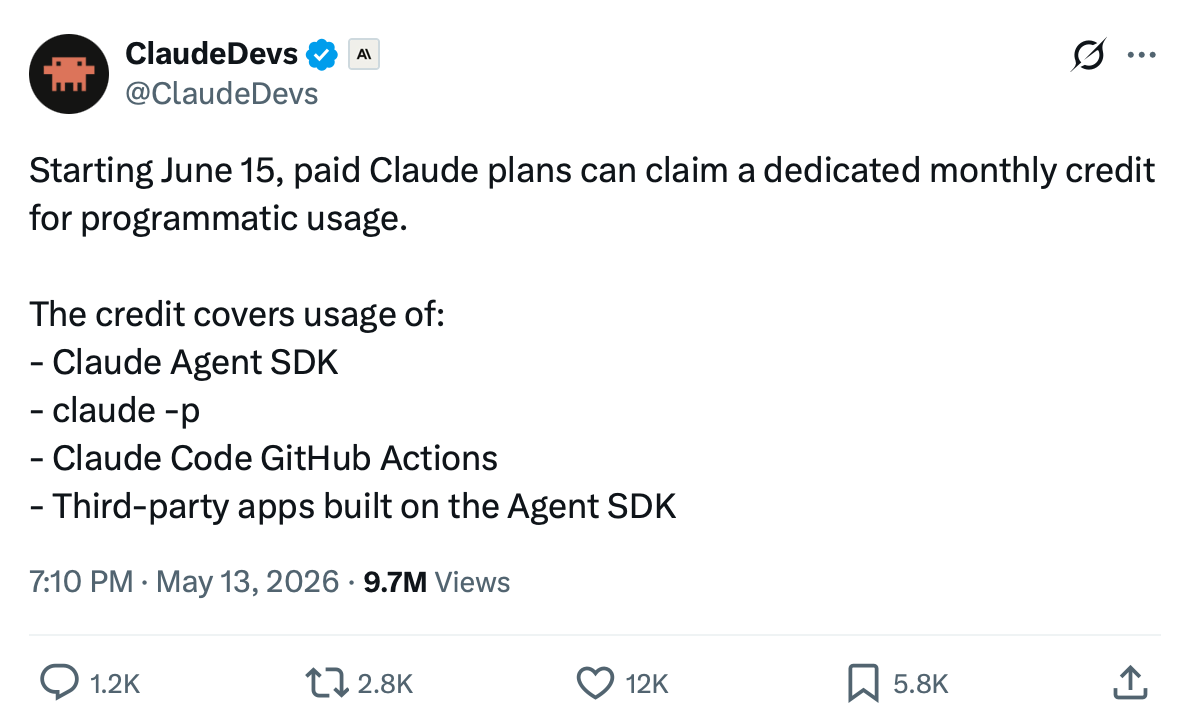
Anthropic has changed the terms for using the Claude Agent SDK with existing Claude plans. Starting June 15, 2026, the Claude Agent SDK, claude -p, the Claude Code GitHub Actions integration, and third-party apps based on the Agent SDK will no longer count against the normal subscription limits. Instead, there will be a separate monthly Agent SDK credit: 20 dollars for Pro, 100 dollars for Max 5x, and 200 dollars for Max 20x. After that, usage only continues if Extra Usage is enabled, then at standard API prices. The actual terms are here: Use the Claude Agent SDK with your Claude plan.
The X announcement sounds friendly at first: subscriptions now get Agent SDK credits. To me, though, it is a clear product boundary. Exactly the non-interactive and automated workflows that made Claude valuable to me are being moved out of the flat-rate subscription and into a usage model.
Thursday morning, I wake up, email from Anthropic in my inbox. Programmatic Usage will be sorted into separate buckets going forward. Agent SDK here, claude -p there, interactive usage somewhere else again. My first thought was not “Ah, fair product differentiation.” My first thought was: Oh shit, I need to get away from Claude. 😅
Not because I think this is dramatic, but because I know my numbers. I generate roughly 1,900 dollars of usage per month. I do not want to pay those 1,900 dollars every month, and honestly I cannot. And then it becomes real: If my agents only work as long as Anthropic cross-subsidizes my usage, then I have not built stable automation. I built on a marketing flat rate.
That is the point where I cancel my Anthropic subscription. Not because the Claude models suddenly became bad. Quite the opposite: Opus is still one of the best models for many coding and agent tasks. That is exactly why I paid for the subscription: not because I particularly liked the Claude products or Anthropic’s UI, but because it gave me access to Opus. The value was in the model, not in the product around it.
What made Claude Pro valuable to me
Claude Pro was never just a better chat window for me. It was an affordable compute source for my tinkering. claude -p and the Agent SDK were especially important because they pulled Claude out of the interactive chat box.
I built automations around those interfaces. That includes my own Telegram agent that uses Claude as its backend (yes, I have one of those 🙈). And workflows like that are probably exactly why Anthropic is now pulling this usage out of the normal subscription limits: It is no longer “one human chats with Claude,” but programmatic model usage with potentially very high consumption.
But come on, this is not only about aggressive power-user setups. There are also very harmless and obvious workflows. Using claude -p in a CI/CD pipeline to run automatic code reviews on pull requests is not abuse. It is exactly the kind of developer automation a good coding model should be built for. Anthropic even explicitly names the Claude Code GitHub Actions integration as part of what will be paid from the Agent SDK credit going forward.
Anthropic marketing: “Build agents! Automate your work with AI!” Anthropic fine print: “but pleeease not with your subscription” 🌚
The other big point is UX freedom. The Agent SDK makes it possible to build a different interface for the same models. That matters because, honestly, Anthropic’s products are not the best software and UX environment for my workflow. In Claude Code in the terminal, longer sessions quickly become hard to keep track of. The desktop integration feels loveless to me. I am not alone with that feeling, as a Claude Code issue asking for an official desktop GUI shows. It names concrete pain points: chat history management, side-by-side views for code changes, file trees and conversation context, and better accessibility (anthropics/claude-code#5103).
I like using T3 Code for that ☺️ T3 Code describes itself as a minimal web GUI for coding agents, currently including Claude and OpenCode. That kind of layer is valuable to me: not because it delivers a different model, but because it puts a better working interface on top of existing agents. Similar projects like CCUX show the same need: a desktop UX for Claude Code with sessions, artifacts, Git integration, and better overview. This exists not despite Anthropic, but because of Anthropic. Because their own UX is not enough for many people.
Why Anthropic is doing this
Well, money. What else.
My own usage illustrates the problem pretty well: 1,900 dollars of usage per month, while I pay around 100 euros for it. And I am definitely not the only one 🌚. That this could not last forever is not a surprise. A 100- or 200-dollar credit is not a replacement for the previous subscription expectation in a workflow like this. It is more like a transition sign toward API billing. Agents consume tokens differently than chat users. They run longer, iterate more, call tools, read a lot of context, try things, and make mistakes that then need to be corrected.
I get that, business-wise. A subscription works when the median user chats occasionally or works interactively in Claude Code. It does not work when power users like me use it as a cheap compute flat rate for autonomous systems, CI/CD, and non-interactive agents.
That makes the product strategy pretty clear. Anthropic is not simply selling the best model at the best place in the workflow. Anthropic is selling an ecosystem. Claude, Claude Code, Claude Desktop, Agent SDK, credits, Extra Usage, API-key paths. Everything is supposed to route back into their own product and billing logic. If Opus works better in OpenCode, that is an argument for OpenCode from a user’s perspective. From Anthropic’s perspective, it is a problem because the value is then in the model and not in the controlled product ecosystem.
And this is not new. Anthropic has made clear for a while that third-party products cannot simply offer claude.ai login or Pro/Max plan limits for their own products. Anthropic says it themselves: “Unless previously approved, Anthropic does not allow third party developers to offer claude.ai login or rate limits for their products” (Claude Agent SDK overview). OpenCode had already had this route cut off earlier: no OAuth access anymore, no use of subscription limits through that path (The New Stack).
The problem is not that Anthropic wants to make money. The problem is that this change hits exactly the workflows that made Claude especially valuable for developers. Anyone who seriously uses agents builds around interfaces. When those interfaces are suddenly devalued economically or technically, that is not a small product detail. It is a signal: Do not rely on consumer subscriptions as a stable foundation for agent infrastructure.
What now?
Fastest option: keep using Claude Code as the harness, but swap out the model driver. The point right now is not to immediately replace all the tooling. The point is to keep existing claude workflows, aliases, prompts, CI calls, and claude -p scripts running with as little change as possible while a different provider answers in the background.
Step zero before you migrate anything: track your usage. Not eventually, now. If you do not know what is being subsidized by a subscription today, you also do not know what costs are coming when the marketing ends. I like using CodexBar for that because it supports a lot of providers and at least gives me a feel for which workflows are actually expensive (I went without it for a while and then realized: without it is stupid 🙈)
That works if the provider offers an Anthropic-compatible API. Claude Code can be pointed at another endpoint via ANTHROPIC_BASE_URL. A simple technical proof of concept is Z.AI with GLM:
export ANTHROPIC_AUTH_TOKEN="..."
export ANTHROPIC_BASE_URL="https://api.z.ai/api/anthropic"
exec claude "$@"
Important: To me, this is not a quality replacement for Opus. I tested GLM and discarded it again for my use case. The answers were not stable enough, sometimes with Chinese text fragments (lol), and the agent personality felt flatter than with Opus. But as a POC, it shows the decisive point: Claude Code is not magic. It is a harness. If you can swap the endpoint, Anthropic’s lock-in is weaker than it looks.
The second proof of concept is OpenAI or ChatGPT/Codex as the driver behind Claude Code. That is fiddlier because the APIs are not identical. You need an Anthropic-compatible intermediate layer for it. LiteLLM can provide a /v1/messages endpoint; additionally, with some backends, you need a small compatibility proxy that rewrites Anthropic system prompts into normal user context because the ChatGPT subscription backend handles system messages differently.
The switch is technically easier than expected. Quality-wise, it is not a drop-in replacement. Every model has different strengths, different weaknesses, and feels different inside an agent. You have to test it yourself, not just bend the endpoint.
uv tool install 'litellm[proxy]'
litellm --config config.yaml --port 4000

export ANTHROPIC_AUTH_TOKEN="dummy"
export ANTHROPIC_BASE_URL="http://localhost:4000"
claude -p "Say a quick hello"
If you can replace the model layer, Anthropic loses part of the lock-in. For a quick migration, that is often more important than perfect architecture.
The obvious option within Anthropic is, of course: enable Extra Usage or use API keys directly. Clean, official, probably the most stable solution. But then you should do the math honestly: You are no longer paying for a subscription for agent infrastructure, but for API usage with a small monthly discount in front of it.
Long term, you can also change the harness. Codex, OpenCode, it is all there. But that is a bigger step. For the immediate case, the more interesting question is whether you can keep using the existing Claude Code CLI without rebuilding all automations right away. That is what these POCs are for.
FYI: This is not just theoretical open-source romance. The AkitaOnRails LLM Coding Benchmark shows a direct comparison that is much more relevant to my argument than any general model leaderboard: the same model, Claude Opus 4.7, running in Claude Code and in OpenCode on the same Rails/RubyLLM task. The numbers below are a snapshot from the current benchmark reports; with benchmarks, always check the README and reports again before drawing hard conclusions.
| Model | Harness | Result | Interpretation |
|---|---|---|---|
| Claude Opus 4.7 | Claude Code | Tier 3 in the solo variant; hallucinated chat.complete, around $6.74, 11m | The first-party harness was not the best place for its own model here |
| Claude Opus 4.7 | OpenCode | 97/100, Tier A, correct RubyLLM API, around $4.04, 18m | The same model delivered clearly better correctness and lower cost in the alternative harness |
| Claude Opus 4.7 + Sonnet/Haiku Executor | Claude Code forced delegation | 92/100 with Sonnet, 90/100 with Haiku | Claude Code could be repaired through delegation, but still stayed behind OpenCode solo |
That is exactly my point: Opus is the valuable part, not necessarily Claude Code. If Anthropic stops me from using Opus in the harness where it works better for my workflow, then Anthropic reduces the value of my subscription. Not because the model gets worse, but because access gets worse.
My take
The AI subscriptions we got used to were never the real pricing structure. They were marketing. Loss-leader marketing. They got us used to receiving a lot of model performance for very little money so we would build workflows, habits, and dependencies.
Now we are seeing the first clear path toward profitability: usage that is too expensive or too automatable gets cut out of the flat rate and moved into credits, Extra Usage, or API prices. That is now happening to the Agent SDK, to claude -p, and to GitHub Actions. Anyone who thinks it stops there has not done the cost calculation.
Whether interactive Claude Code usage remains in the flat rate long term is open. Today, according to Anthropic, it remains unchanged in the normal subscription limits. I still would not bet my architecture on it.
So real talk: Anyone running agents should not plan as if consumer subscriptions will remain a stable infrastructure foundation. Models need to be replaceable. Harnesses need to be portable. Automations must not depend on a single consumer plan. Everything that feels “unlimited enough” today is only unlimited until it shows up in the cost accounting.
Consequence for me: I will lean more heavily on OpenCode and flexibility in the future 🤓 Concretely, that means new agent workflows run through OpenCode first for me, and I am gradually moving existing Claude Code automations out of subscription dependency. Not because OpenCode is magic, but because it lets me separate harness, model, and billing from each other. If Anthropic becomes too expensive, I need to be able to switch. If OpenAI is better or cheaper at the moment, I need to be able to switch. If another provider fits a specific workflow better, I need to be able to switch. The subscription must no longer be the architecture decision.
Goodbye Anthropic therefore does not mean, to me: Claude is bad. It means: I am no longer paying for a subscription whose most important benefit is being removed. The rest is probably just waiting to be next. I no longer want to build my agents around one provider, but around replaceability.