How Much AI Can I Afford?
After the Anthropic cut, I compare my Claude Code usage against API prices and look at which models still fit into my 100-dollar budget.
After my last Anthropic post, the emotional part was done. Cancel, complain, stare dramatically out the window for a bit. All good.
But then came the more annoying question:
If I no longer want to rely on subscription magic, how much LLM can I actually afford with roughly the same budget?
Not as a gut feeling. Not as “AI will probably get cheaper anyway.” But with my real Claude Code usage from the last 30 days.
The Absurd Comparison
Then I stumbled over Peter Steinberger’s CodexBar screenshot. It showed something like 1.3 million dollars in token costs. Not as an actual invoice, but as the API equivalent behind some very generous subscription world.
And yes, absurd. Good for him. But I am not Peter Steinberger, and my budget is not “lol, seven figures.”
My question is smaller and more boring, but much more relevant to me: What is possible with roughly 100 dollars per month?
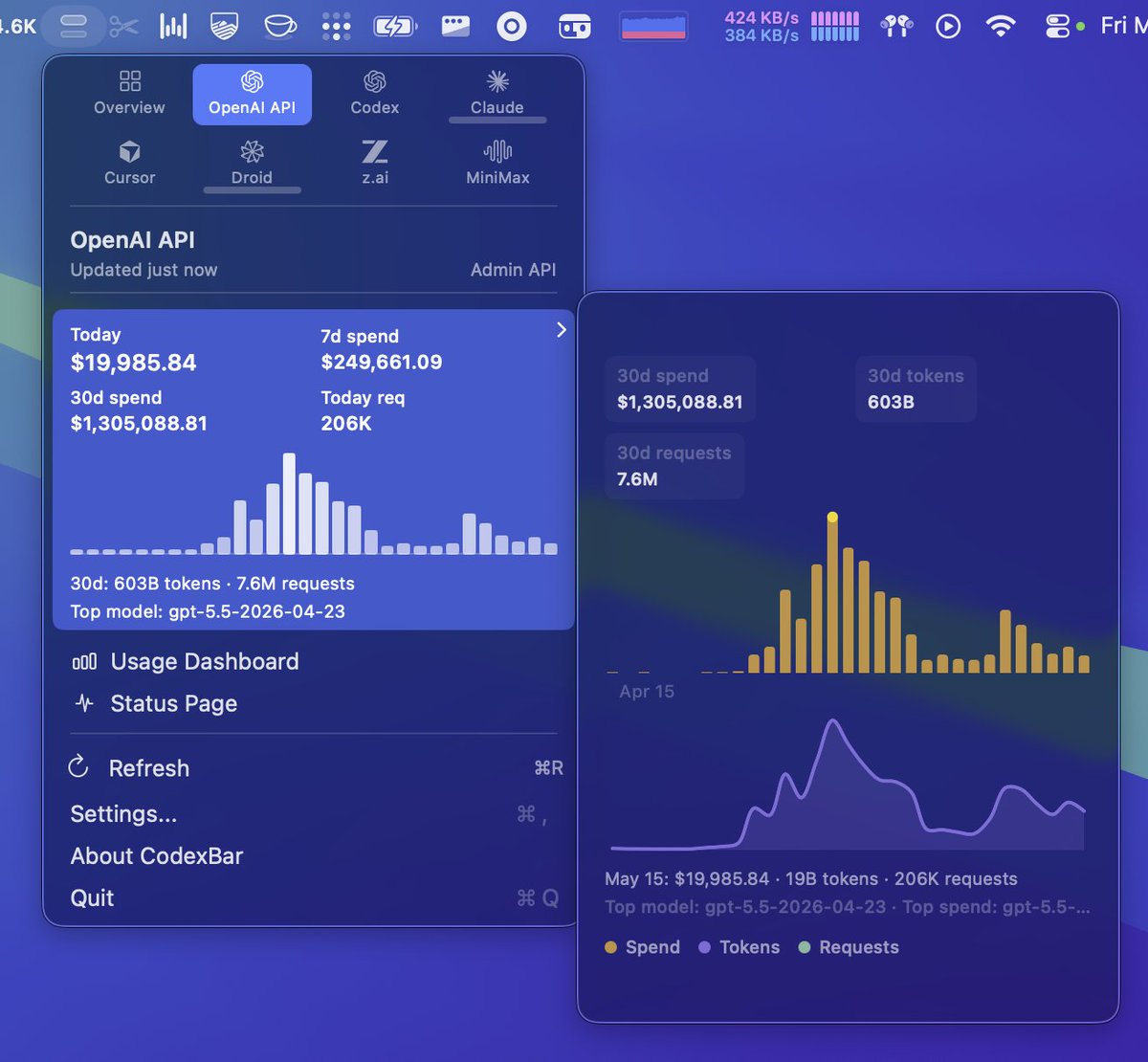
Screenshot: CodexBar shows 1,305,088.81 dollars 30d spend and 603B tokens.
By the way, CodexBar is a genuinely cool tool for checking on a Mac how much your own usage would cost as an API equivalent, or how much usage you still have left in your subscription. For that alone, Peter deserves thanks. I find it pretty useful to have a tool like this because otherwise all these subscription costs just disappear into the fog.
My 30 Days of Claude Code Usage
So instead of trying to estimate this theoretically, I analyzed my local Claude Code sessions. Claude Code stores session data locally, and there is enough information in there to roughly calculate token usage and API-equivalent costs.
That turned into a small CLI: claude-costs. Not pretty, not scientifically perfect, but built exactly for this question: What would my usage have cost without a subscription, and which models still fit into my budget?
You can find the tool here: mrsOwlex/claude-costs
For this post, I analyzed 30 days, from April 25 to May 24, 2026. In that period, there were 861 local session files lying around, totaling roughly 310 MB. Those became 5,612 deduplicated requests.
The result hurt a bit:
- approx. 741K uncached input tokens
- approx. 3.0M output tokens
- approx. 401.9M cache read tokens
- approx. 56.6M cache write tokens
- approx. 462.2M tokens total
At Anthropic API prices, this trace would land at roughly 814.52 dollars for the month.
Important: This does not mean I throw 462 million completely new tokens into the world every month. Most of it is cache. But that is exactly part of the cost reality of agentic coding. The agent reads context, keeps context, reuses context, iterates, calls tools, does nonsense, corrects nonsense. Without cache, this would be completely absurdly expensive. With cache, it is only “haha, ouch.”
What Still Fits Into 100 Dollars?
After that, I priced the same trace against OpenRouter prices. This is not a proper benchmark. But it gives me a gut feeling and a reality anchor. I am not saying: This model can handle my workflow just as well. I am only pricing the same observed token trace against other model prices.
That is where it gets interesting. Many premium models immediately drop out. Claude Sonnet 4.6 would be clearly above my 100-dollar budget in this calculation. Claude Opus anyway. GPT-5.5 too.
But some models suddenly land in a range that is relevant to my question. DeepSeek V4 Pro comes out at roughly 35 to 105 dollars per month in my calculation. So not clearly “fits easily,” but more: it could fit if cache and agent behavior stay somewhat similar. Gemini Flash, Qwen Coder Flash, GPT-5 Mini, and a few others are also in ranges that are not completely absurd.
My Take
For me, this is not just a funny token calculation. After the Anthropic cut, I first switched to an OpenAI subscription. That is the pragmatic path right now. But it does not solve the actual question permanently.
Because the same thing applies there: If I seriously use agentic workflows, I need to know what range I am operating in. I do not use AI only as a chat window. I have personal agents, background workflows, coding assistants, things that are supposed to take over longer tasks. Of course that creates high usage. That is exactly why I do not want to look at the costs only after some subscription boundary gets moved.
And I do not think this is only my private nerd problem. In team contexts, you can see the same movement. People feel their way into agentic tooling: first small tasks, then bigger refactorings, then reviews, then automations. At first it feels like “we have the subscription anyway.” But as soon as those workflows run on real API prices, the question becomes very plain: Is the result good enough that we really want to pay the token bill for it? Or are humans maybe just better at that point after all?
That is exactly why I wanted to build claude-costs. Not because the calculation is perfect, but because “no idea, it will probably be fine” is a bad cost strategy.
If you do not want to simply increase your budget, you can at least check: What does our current workflow roughly cost? Which models would be realistic? And where is the line between “this really helps us” and “we are burning tokens because it currently feels free”?
Anthropic already reminded me pretty clearly with the Agent SDK change that not every kind of usage will remain inside a subscription forever (Goodbye Anthropic). So if I do not want to build my automation on coupons and marketing flat rates, I need to know what the usage costs without those discounts, which alternatives are realistic, and whether they would even be worth it quality-wise.
I do not want to use less AI. I just want to know how much AI I can afford without lying to myself.